



PD-AI
Cover
© 2026 Sitthatka Jaratsaeng · Design: TemplateMo

Artificial Intelligence Model for Parkinson Classification via Facial Movement Analysis

We propose a unified framework for predicting Parkinson’s disease, disease severity (Hoehn & Yahr stage), and motor impairment (MDS-UPDRS Part III) using facial movement features.

Introduction of Artificial Intelligence Model for Parkinson Classification via Facial Movement Analysis
2 min
Details →

Developers

Sitthatka Jaratsaeng

Student

Sitthatka Jaratsaeng

Narongrit Kasemsap

Co-Advisor

Narongrit Kasemsap

Anchalee Techasen

Research Consultant

Anchalee Techasen

Thanapong Intharah

Advisor

Thanapong Intharah

Abstract

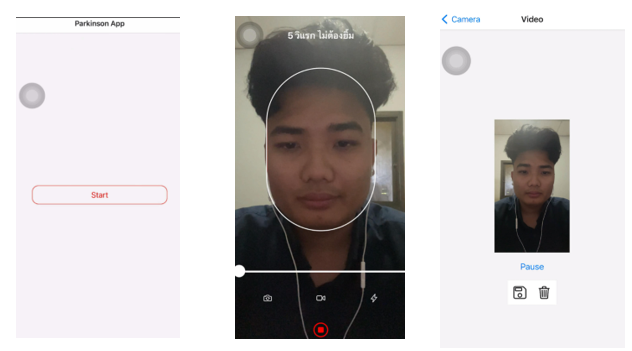
Parkinson’s disease (PD) is a neurodegenerative disorder characterized by motor impairment and reduced facial expressiveness. This study aimed to evaluate the potential of using facial video data captured solely from a smartphone front camera from a total of 40 participants to predict Parkinson’s disease, disease severity (Hoehn & Yahr), and motor examination score (MDS-UPDRS Part III).

In this study, three predictive models were developed and evaluated, along with five video processing methods and four facial action scenarios. For Parkinson’s disease classification, the best performance was achieved using frame-skipping combined with Principal Component Analysis (PCA) retaining 95% variance and smile videos with the XGBoost model, yielding an accuracy of 0.77, precision of 0.75, and recall of 0.86. For predicting disease severity (Hoehn & Yahr), the lowest Root Mean Squared Error (RMSE = 1.3136), Mean Absolute Percentage Error (MAPE = 38.36%), and Coefficient of Determination (R² = 0.2421) were obtained using smile videos with frame-skipping without PCA through the Random Forest model. For predicting the motor examination score (MDS-UPDRS Part III), the best performance was achieved using smile videos processed by averaging every three frames combined with PCA (95% variance) and the XGBoost model, resulting in RMSE = 19.3365, MAPE = 45.33%, and R² = 0.1073.

Regarding feature importance, both the Parkinson’s disease classification model and the disease severity prediction model shared four common Action Units: upper lip raiser, lip corner raiser, lip corner depressor, and lips part. These findings confirm that facial information has strong potential as a meaningful signal for Parkinson’s disease assessment and may be further developed into an easy-to-use smartphone-based tool. Such an approach could reduce the clinical assessment burden while maintaining a high level of predictive performance.

Methodology

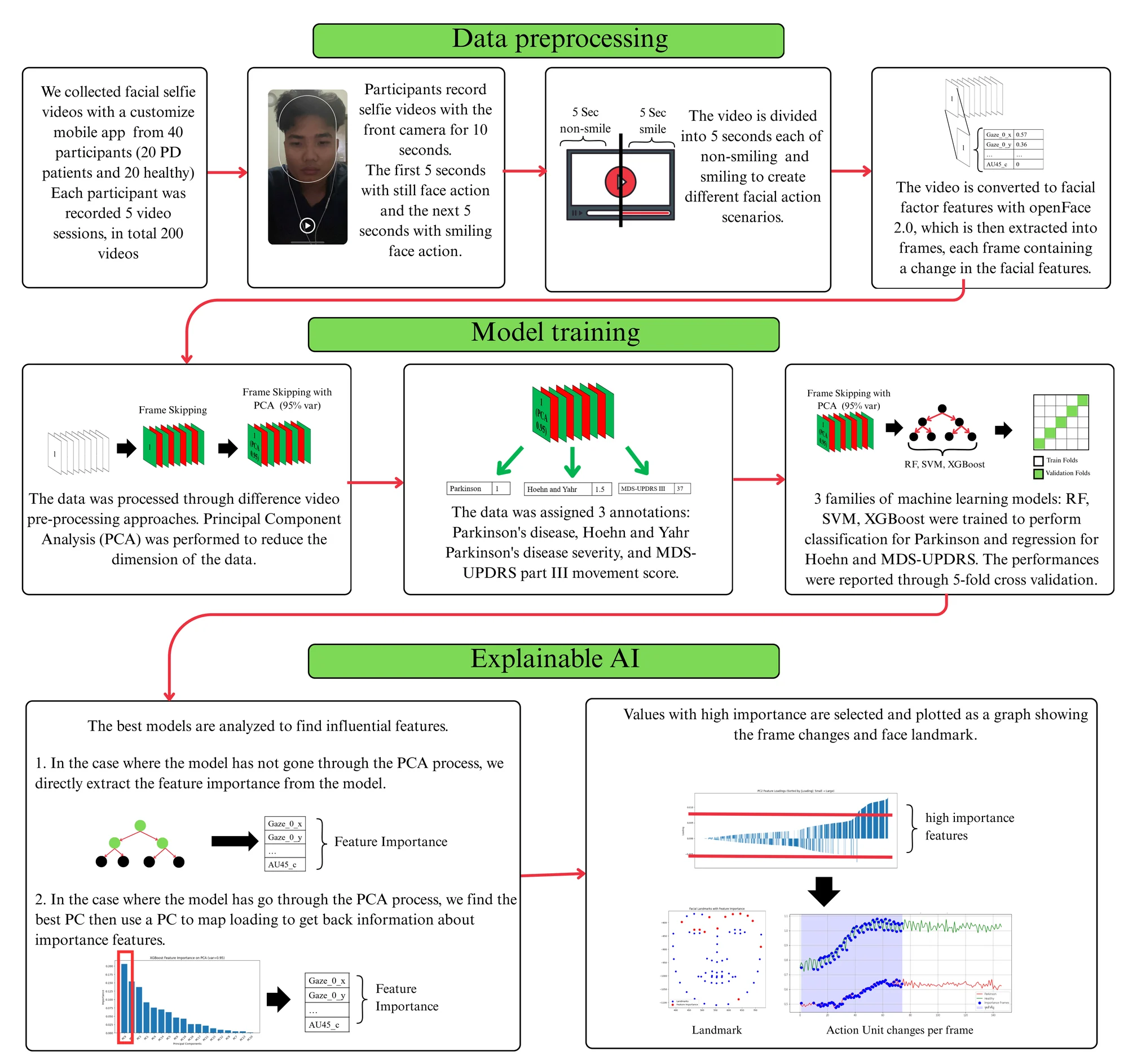
This figure presents the overall framework of the proposed methodology. Facial videos were collected using a smartphone front camera from 40 participants. The videos were processed using five different preprocessing techniques, including frame-skipping and frame averaging, with optional dimensionality reduction using Principal Component Analysis (PCA). Extracted facial features and Action Units were then used to train three machine learning models (Random Forest, Support Vector Machine, and XGBoost) for Parkinson’s disease classification and prediction of disease severity (Hoehn & Yahr) and motor examination score (MDS-UPDRS Part III). Model performance was evaluated using classification and regression metrics, including Accuracy, Precision, Recall, RMSE, MAPE, and R².

Credits

This website utilizes the Lustro Slideshow template developed by Sitthatka Jaratsaeng. We gratefully acknowledge the original design.

Copyright© 2026 Sitthatka Jaratsaeng
Website bySitthatka Jaratsaeng